Online Books Melancholy Elephants Free Download
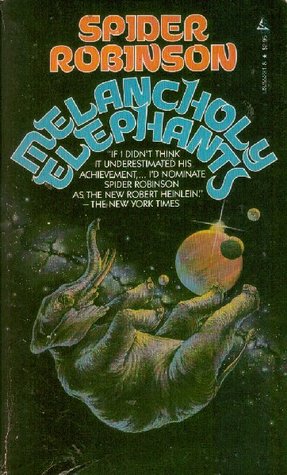
Spider Robinson
Paperback | Pages: 244 pages Rating: 4.1 | 334 Users | 18 Reviews

Details Containing Books Melancholy Elephants
| Title | : | Melancholy Elephants |
| Author | : | Spider Robinson |
| Book Format | : | Paperback |
| Book Edition | : | Special Edition |
| Pages | : | Pages: 244 pages |
| Published | : | May 28th 1985 by Tor Books (first published June 1984) |
| Categories | : | Science Fiction. Short Stories. Fiction. Fantasy |
Narrative To Books Melancholy Elephants
Science fiction? You mean rocketships and rayguns and the li'l robots? Alien monsters, evil computers, expensive special effects?
Well, no. You won't find any of that here. You're confusing modern science fiction with sci-fi - a perfectly understandable error. Sci-fi - the plural of "scum fum" - refers to certain very bad films made by Hollywood and/or Canadian dentists in need of tax shelters. Sf, on the other hand, (lower case) is the correct abbreviation for science fiction, the 'literature' of speculative entertainment; deprived of novel visual effects, we try to substitute novel 'ideas'. Our only connection with the movies is that they feel free to steal our ideas whenever the special effects budget falls short.
Who says the Golden Age of 'sf' is gone? The flame kindled by Heinlein, Asimov and Clarke is still burning brightly, carried forward by the likes of Ken Liu and Spider Robinson. In a passionate introduction to this collection covering more than two decades of his writings, Mr. Robinson makes the case that science fiction is not only the place where new ideas are tried out for size by humanity, but also a lot of FUN! Smart entertainment being what we really need in order to pick ourselves up from the grimdark pit we have dug for ourselves. Here's another quote from the introductory essay:
Sf mediates between the scientist and the poet, between those who observe and measure and those who dream. It stands midway between objective truth and subjective truth, seeking perpetually to reconcile the two, because this is essential to the continual survival of the human race and because it pays good money, and because, as I mentioned earlier, it turns out to be fun.
That is why I write sf. Because I am a grownup artist and a fair entertainer, and morale on Starship Earth has been pretty rotten lately. And because I enjoy it.
The passion for the genre and for word games, the laidback atitude and (generally) optimistic predictions for the future make this collection one of my personal favorites, to be added to the couple of other irreverent and friendly stories I heard over the bar at "Callahan's Crosstime Saloon" [Time Travellers Strictly Cash!] . Robinson pays homage to Heinlein by name in a couple of the stories included, but for me his style and his engagement are closer to another favorite from the Golden Age, Ray Bradbury, and to one of his most memorable quoets:
People ask me to predict the future, when all I want to do is prevent it. Better yet, build it. Predicting the future is much too easy, anyway. You look at the people around you, the street you stand on, the visible air you breathe, and predict more of the same. To hell with more. I want better.
>><<>><<>><<
Melancholy Elephants the title story and the opening salvo in the battle for the future of humanity, paints a rather bleak future. Senators are still willing to be bought and to sponsor legislation written by corporate lobbyists. One such anti-consumer bill spells nothing less than our common extinction, at least according to a union negotiator who tries to argue against extending copyright on artistic works in perpetuity.
Don't you see what perpetual copyright implies? It is perpetual racial memory! That bill will give the human race an elephant's memory. Have you ever seen a cheerful elephant?
I will not repeat the arguments in my review, but I think the story is well chosen to illustrate the way ideas matter and why any law that stifles innovation and imagination spells trouble for our survival.
Antinomy - explores the interpersonal complications that arise from radical medical breakthroughs. A powerful tycoon is frozen after she is diagnosed with an untreatable cancer. She falls in love with her doctor just before being put to sleep, but when she is defrosted she remembers nothing of her last months, including her romance. Now she has to adjust to a future world where another man expresses his affectionate interest. What is the right choice for her, between the man who grew old, sacrificing his life to find a cure for her, and the younger man who is closer now to her age?
antinomy = contradiction between two propositions which seem equally urgent and necessary.
Half an Oaf : the future is so bleak that some people would buy cheap replicas of time machines from the black market in order to escape back to Brooklyn in the 80's. When the device malfunctions hilarity ensues and the irate time-traveller needs to rely on a teenage urchin named Spud to save his bacon.
Satan's Children is one of my favorites in this collection and brings sf into the "sex, drugs and rock'n roll" sphere. A young folk singer does small recitals in an underground bar for the connoiseurs ( Any serious musician will sell his or her soul for an intelligent, sensitive, 'listening' audience. ) , singing mostly about his love for his girlfriend, also a singer. One night they witness a drama that might change the world, if only they are smart enough and courageous enough. An old man is killed in front of their eyes by a secret agent, but before he dies he manages to give them the secret formula for a new drug - a drug that makes people tell the truth, the whole truth and nothing but the truth.
All right, children, into your hands I place the fate of modern civilization. I bring you Truth, and I think that the truth shall make you flee.
Robinson is at his best when he talks about the subjects he cares about the most - in this story music, puns, friends and free love [and drugs :-)]. If a little pill can make you a better person, why should governments and police and religious zealots all get their pants in a twist?
I think the biggest single problem in the world, for almost the last two decades, has been morale. Despairing people solve no problems.
No Renewal is one of the saddest stories in this collection. I cannot put a positive spin on it : the future is grim, and the planet is exhausted. When oil reserves are depleted , corporations turn to the industrial exploitation of clay, destroying in the process an iddylic piece of agricultural land. A single old man survives, surrounded by factories, in a derelict shack, picking over old photographs on his 90th anniversary.
If a farm surrounded by wasteland cannot survive, how then shall a man?
In the Olden Days is a variant / a riff on the same theme. We all know that people as they get older are prone to drone endlessly about their good old days. But what if they are actually telling the truth?
Not Fade Away is for me a short and sweet Bradbury kind of story. Two entities meet in the emptiness of galactic space, transhumans evolved over millenia. One of them is the last Warrior, unemployed for countless years after humans and aliens develop telepathic powers that make wars impossible. The other is ... something else. The question posed here is : Can we live without our reptile brain and without individual identity / privacy?
True Minds is a love story with a scientific twist. A writer becomes world famous for writing the most insightful and the most heartfelt love stories ever published. How does an author gain such knowledge, such empathy?
Love rides his back like a goblin. It lives in his belly like a cancer. He wears it like a spacesuit in a hostile environment. It wears him like a brake drum wears shoes. I can't tell whether he generates love or the other way around.
He is a recluse, avoiding all contact with the press or with the fans, yet 'groupies' keep trying to throw themselves at his feet. Some of them have so much power and money that they cannot be avoidedd. Or can they?
The story is dedicated to Heinlein, whose definition of love, 'as opposed to lust or affection or need or any of a dozen other cousins' is used as the anchor to the story:
'That condition in which the welfare and happiness of another are essential to your own'
Chronic Offender is one of the best examples of writing for fun and profit. Subversive time traveller stories are something of a specialty for Robinson, and here we have a tourist from the past we are better of without. Harry the Horse is a mob hitman from Harlem in the 1930's. Somehow he gets his paws on a brand new time machine and comes to Harlem in the early 90's to get precious info on horse races and baseball scores, to be used for profit when he gets back to his timeline. In the future he tries to rob one of his old pals apartments, only to find the old timer still alive. Old slang dialogue mixes with some rather bloody minded tempers to ask us whether time travel really is a good thing, after all. A nod to one of the greates comedians from the era is included:
"I like a gal with a strong will. Or at least a weak won't." [Groucho Marx]
It's a Sunny Day is the story that made me buy the whole collection after I came across it online. It's about a future that is both depressing and uplifting. And about the important things in life.
They tell me you can read a page at a glance, Basic English and Fortran, and remember it a decade from now, letter-perfect in a cafe with the band playing. You know enough to converse intelligently with experts in a hundred specialized disciplines, and direct their work for maximum efficiency. They trained and sleep-taught and indoctrinated you in logical and non-logical analysis until you were eight, stuffed you with data until you were twelve, gave you four years to integrate it and then put you to work at sixteen. Only you didn't work.
Genetic manipulation allows future governments to create super-intelligent individuals in a test tube. The goal is to find solutions for over-population and exhausted natural resources. When the project fails, the teenage genius is sent to a holiday on a backwards, underdeveloped planet. I might point out here that the author has chosen to move from New York to Canada in the seventies, turning his back in his own way to a consumerist society.
High Infidelity is another subversive take on love, this time with a kinky twist, not only a scientific one. Prepare to be scandalized about role-playing between the sheets... or not! The title may be a play on words about one of my favorite books and movies by Nick Hornby.
Rubber Soul is weird and it's somehow connected to the Beatles song of the same name! I think I better leave it like this, unreviewed, and segue into the soundtrack listing that the collection prompted me to compile:
- The Beatles - "Norwegian Wood" (discussed in the story "True Minds": There's an old John Lennon song, 'Norwegian Wood.' I've always felt that he changed the title to avoid censorship. I think the song is about the nicest compliment a man can receive from a woman. Isn't it good? : 'knowing she would'. )
- The Beatles - "Happiness is a Warm Gun"
- The Lovin' Spoonful - "Daydream"
- The 5th Dimension - "Aquarius, Let the Sunshine In"
- Melanie - "Brand New Key"
- Barry McGuire - "Eve of Destruction"
- Marvin Gaye - "Mercy, Mercy Me (The Ecology)"
- Edison Lighthouse - "Love Grows (Where My Rosemary Goes)"
- Arlo Guthrie - " Alice's Rock'n Roll Restaurant"
The last song is also an invitation to go visit Callahan's Crosstime Saloon and buy the author a beer if you happen to be in the neighborhood.
Cheers!
Itemize Books Toward Melancholy Elephants
| Original Title: | Melancholy Elephants |
| ISBN: | 0812552318 (ISBN13: 9780812552317) |
| Edition Language: | English |
| Literary Awards: | Hugo Award for Best Short Story for “Melancholy Elephants” (1983), Locus Award Nominee for Best Short Story for "Melancholy Elephants" (1983), Analog Award for Best Short Story for "Melancholy Elephants" (1982) |
Rating Containing Books Melancholy Elephants
Ratings: 4.1 From 334 Users | 18 ReviewsAssess Containing Books Melancholy Elephants
There's something about Spider's writing that always gets me. His characters actually love and care about each other. Took me a while to realize how uncommon this is in most literary, fiction, sf, f, or spec writing.Plus he's got some twisted stories in this collection.More short stories.
Contains an excellent story on the Copyright Legislation that is still being fought...
Science fiction? You mean rocketships and rayguns and the li'l robots? Alien monsters, evil computers, expensive special effects?Well, no. You won't find any of that here. You're confusing modern science fiction with sci-fi - a perfectly understandable error. Sci-fi - the plural of "scum fum" - refers to certain very bad films made by Hollywood and/or Canadian dentists in need of tax shelters. Sf, on the other hand, (lower case) is the correct abbreviation for science fiction, the 'literature'
Science fiction? You mean rocketships and rayguns and the li'l robots? Alien monsters, evil computers, expensive special effects?Well, no. You won't find any of that here. You're confusing modern science fiction with sci-fi - a perfectly understandable error. Sci-fi - the plural of "scum fum" - refers to certain very bad films made by Hollywood and/or Canadian dentists in need of tax shelters. Sf, on the other hand, (lower case) is the correct abbreviation for science fiction, the 'literature'
Again, seriously good shorts, though it duplicates many of the stories in another collection or two.
Some of the best stories:Melancholy elephants AntimonySatan's Children It's a sunny dayHigh Infidelity
0 Comments